Image Features
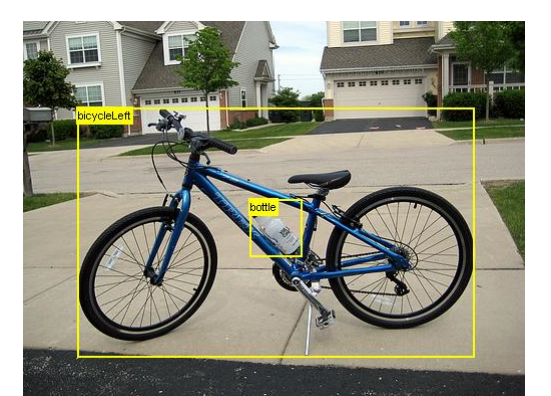
- Image features are essentially vectors that are a compact representation of images •
- They represent important information shown in an image •
- Intuitive examples of image features:
- Blobs –
- Edges –
- Corners –
- Ridges –
- Circles –
- Ellipses –
- Lines –
- Etc…
We need to represent images as feature vectors for further processing in a more efficient and robust way
Examples of further processing include: –
- Object detection –
- Image segmentation –
- Image classification –
- Content-based image retrieval –
- Image stitching –
- Object tracking
Properties of Features
- Why not just use pixels values directly? –
- Pixel values change with light intensity, colour and direction – They also change with camera orientation – And they are highly redundant • Repeatability (robustness) – Should be detectable at the same locations in different images despite changes in illumination and viewpoint • Saliency (descriptiveness) – Similar salient points in different images should have similar features • Compactness (efficiency) – Fewer features – Smaller features
Image Pre-processing
Feature Representation
Pattern Recognition
Post-processing
Feature Types
- Colour features –
- Colour histogram –
- Colour moments •
- Texture features –
- Haralick texture features –
- Local binary patterns (LBP) – Scale-invariant feature transform (SIFT) –
- Texture feature encoding •
- Shape features –
- Basic shape features –
- Shape context –
- Histogram of oriented gradients (HOG)
Colour Features
Colour is the simplest feature to compute, and is invariant to image scaling, translation and rotation • Example: colour-based image retrieval
Colour Histogram
Represent the global distribution of pixel colours in an image – Step 1: Construct a histogram for each colour channel (R, G, B) – Step 2: Concatenate the histograms (vectors) of all channels as the final feature vector
Colour Moments
Application Example
Texture Features
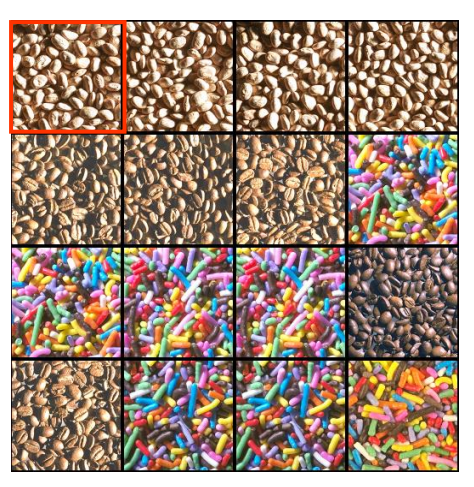
- Texture is a powerful discriminating feature for identifying visual patterns with properties of homogeneity that cannot result from the presence of only a single color or intensity •
- Example: texture classification
Haralick Features
- Haralick features give an array of statistical descriptors of image patterns to capture the spatial relationship between neighbouring pixels, that is, textures –
- Step 1: Construct the gray-level co-occurrence matrix (GLCM) –
- Step 2: Compute the Haralick feature descriptors from the GLCM
- Step 1: Construct the GLCMs –
- Given a distance d at an orientation angle θ – Compute the co-occurrence count (or probability) of going from a gray level l 1 to another gray level l 2 with an intersample spacing of d along the axis making an angle θ with the x axis and denote this as p(d, θ)(l 1, l 2) – Construct the matrix P(d, θ) with the elements (l 1, l 2) being p(d, θ)(l 1, l 2) – If the number of distinct gray levels in the quantized image is L, then the cooccurrence matrix P will be of size L×L
For computational efficiency, the number of gray levels (L) can be reduced by binning (similar to histogram binning), e.g. L = 256/n, with n a constant factor. – Different co-occurrence matrices can be constructed by using various combinations of distance (d) and angular directions (θ). – On their own, these co-occurrence matrices do not provide any measure of texture that can easily be used as texture descriptors. – The information in the co-occurrence matrices needs to be further extracted as a set of feature values => Haralick descriptors.
Application Example
Scale-Invariant Feature Transform
- SIFT feature describes the texture features in a localised region around a keypoint
- SIFT descriptor is invariant to uniform scaling, orientation, and partially invariant to affine distortion and illumination changes
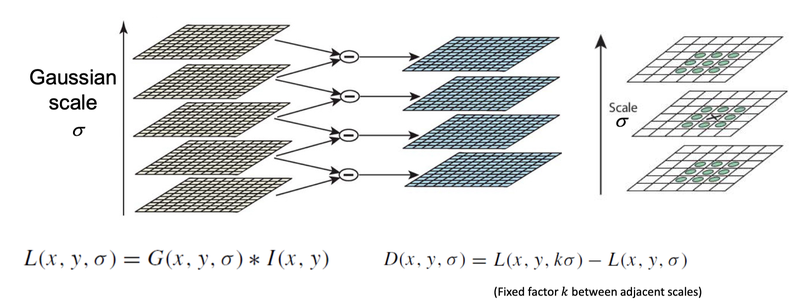
- Scale-Space Extrema Detection: Find maxima/minima in DoG(Difference of Gaussian) images across scales
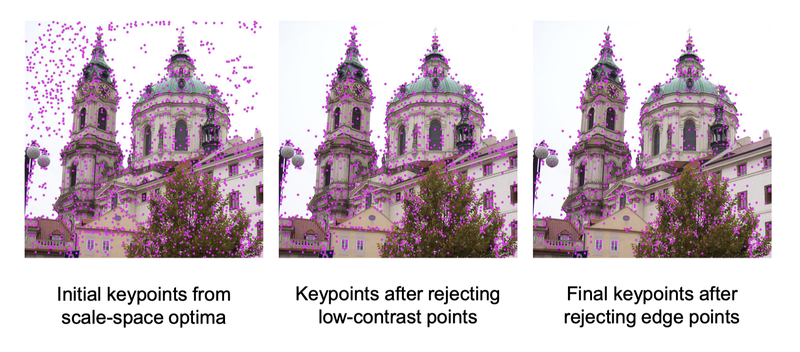
- Keypoint Localization:Discarding low-contrast keypoints Eliminating edge responses
- Orientation Assignment:Achieve rotation invariance
- Keypoint Descriptor:Compute gradient orientation histograms
SIFT Extrema Detection
Detect maxima and minima in the scale space of the image
SIFT Keypoint Localization
- Improve and reduce the set of found keypoints
- Use 3D quadratic fitting in scale-space to get subpixel optima –
- Reject low-contrast and edge points using Hessian analysis
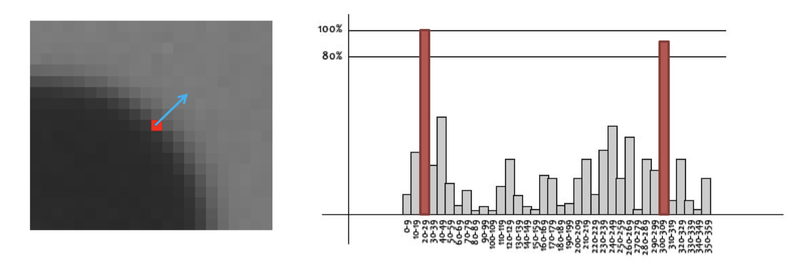
- Estimate keypoint orientation using local gradient vectors – Make an orientation histogram of local gradient vectors – Find the dominant orientation from the main peak of the histogram – Create additional keypoint for second highest peak if >80%
SIFT Orientation Assignment
- Estimate keypoint orientation using local gradient vectors
- Make an orientation histogram of local gradient vectors
- Find the dominant orientation from the main peak of the histogram
- Create additional keypoint for second highest peak if >80%
SIFT Keypoint Descriptor
- 4 x 4 array of gradient histogram weighted by magnitude
- 8 bins in gradient orientation histogram
- Total 8 x 4 x 4 array = 128 dimensions
- 4 x 4 array of gradient histogram weighted by magnitu de
Descriptor Matching
Image stitching – Find SIFT keypoints and feature correspondences
Fitting and Alignment
Given matched points A and B, estimate the transformation Example for translation:
Feature Encoding
Global encoding of local SIFT features – Integrate the local features (SIFT keypoint descriptors) of an image into a global vector to represent the whole image
Most popular method: Bag-of-Words (BoW) – The variable number of local image features are encoded into a fixed-dimensional histogram to represent each image
- Bag-of-Words (BoW) – step 1 – Create the vocabulary from the set of local descriptors (SIFT keypoint descriptors) extracted from the training data – This vocabulary represents the categories of local descripto