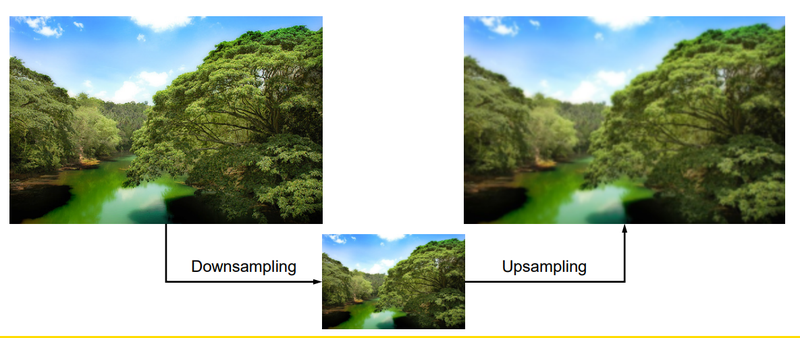
What is lost when lowering resolution?
Fourier's crazy idea:
Any univariate function can be rewritten as a weighted sum of sines and cosines of different frequencies
Spatial versus frequency domain
- The image plane itself
- Direct manipulation of pixels
- Changes in pixel position correspond to changes in the scene
- Fourier transform of an image
- Directly related to rate of changes in the image –
- Changes in pixel position correspond to changes in the frequency
Frequency domain overview
- High frequencies correspond to rapidly changing intensities across pixel
- Low frequency components correspond to large-scale image structures
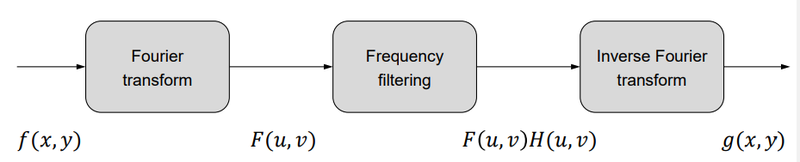
- Frequency domain image processing via the Fourier transform
Definition of the Fourier transform (1D)
- Forward Fourier transform
$F(u) = \int_{-\infty}^{\infty} f(x)e^{-i2\pi ux}dx$
- Inverse transform
$f(x) = \int_{-\infty}^{\infty} F(u)e^{i2\pi ux}du$
- Note:
- $e^{iwx} = cos(\omega x) + i sin(\omega x)$
- when $\omega = 2 \pi u$ is radial frequency
- u is spatial frequency
- $i = \sqrt{-1} $
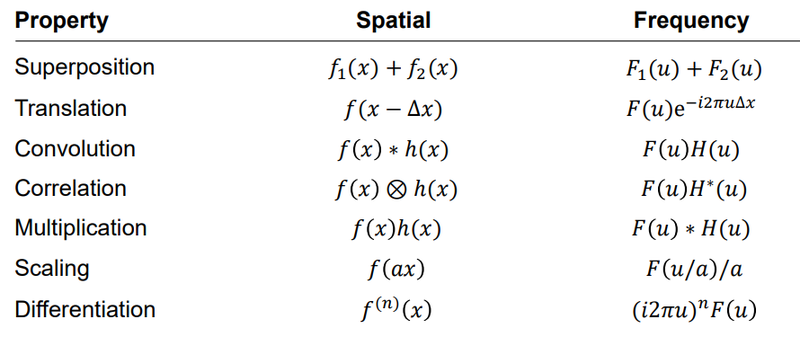
Properties of the Fourier transform
Definition of the Fourier transform
- forward Fourier transform
- $ F(u, v) = \int_{-\infty}^{\infty}\int_{-\infty}^{\infty} f(x,y) e^{-2 \pi (ux + vy)} dx dy $
- Inverse Frourier transform
- f(x,y) = \int_{-\infty}^{\infty}\int_{-\infty}^{\infty} F(u, v) e ^{i2\pi (ux + vy) dudv $
- uses complex valued sinusoids
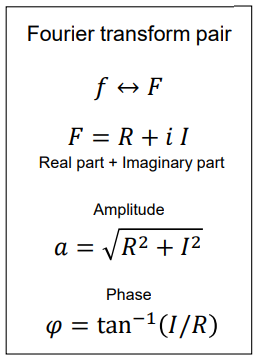
Discrete Fourier transform (DFT)
- Forward discrete Fourier transform
- $ F(u,v) = \sum_{x=0}^{M-1} \sum_{y=0}^{N-1} f(x,y) e^{-i2\pi (\frac{ux}{M} + \frac{vy}{N})} $
- Inverse discrete Fourier transform
- $ f(x,y) = \frac{1}{MN} \sum_{u=0}^{M-1} \sum_{v=0}^{N-1} F(u,v) e^ {i2\pi ( \frac{ux}{M} + \frac{vy} {N} )}$
Frequency domain filtering
- Each $𝐹(𝑢, 𝑣)$ depends on all $f(x,y) $
- •Frequencies in the Fourier domain correspond to patterns in the image •
- The value of $𝐹(0,0)$ is the average intensity over all pixels of the image •
- Low frequencies correspond to slowly varying intensities across pixels •
- High frequencies correspond to rapid intensity changes across pixels •
- Noise typically corresponds to fluctuations in the highest frequencies